Tuesday, 20 November 2012

Slashdot is beyond resuscitation.

    I'm a news junkie. Specifically I'm a tech news junkie. Part of my morning routine involves scanning Google Reader to see what's new from a long list of tech news sites.
    One of the consistencies in my news feed for well over a decade has been the venerable tech news blog, Slashdot. News for nerds, stuff that matters, as the tagline put it. My Slashdot ID isn't one of the really low numbers and I've not used it much but it's low enough to date me to the early 2000s. The site has helped shape my outlook on Internet culture and brought me first news of some of the defining tech stories of the last decade.
    But all good things eventually decline. I first saw whispers that Slashdot was past it and Hacker News was the Place to Be a few years ago and though I followed HN I refused to believe that Slashdot was dead. Sure they sometimes took a day to post a story and there were the inevitable dupes, but nobody's perfect, you insensitive clod!
    This week however I finally see that Slashdot, the Slashdot that I used to know, is dead. Why? I'm at the epicentre of one of their stories. Well, I should say I was at the epicentre, they're not just a day late but a whole week late on a story that was all over mainstream media last Monday. Yes, my US colleagues chose 'GIF'(verb) as their Word of the Year and like your rather out-of-touch elderly relative Slashdot has caught up with a week-old newspaper on the day room coffee table and proudly announced the story as today's news.
    News for nerds, stuff that mattered a week ago. Worth following only for old time's sake.

Tuesday, 23 October 2012

Bye bye analogue telly

   It is with some sadness that I note today sees the turning off of the final UK terrestrial analogue TV transmitter in Northern Ireland. Not because I miss Ceefax or because I hanker again for the days of only three, four, or five channels, but because analogue TV was what gave me my start in electronics when I was a teenager.
    When my contemporaries were doing more conventional 1980s teen stuff like riding BMX bikes or burning away their money on Pac-Man, I was hunting through skips for discarded TV sets, fixing them, learning how they worked, and using them as sources of components for my other electronic projects. I must have had hundreds of them pass through my hands, mostly the sets from the colour TV boom of the early 1970s. I learned the foibles of the Philips G8, the Decca Bradford and the ITT CVC5, I understood how an analogue PAL decoder worked and I picked up what is now one of the most useless skills around for an engineer, converging a delta-gun colour CRT.
    I remember some of my projects, the UHF transmitters fashioned from tuner cavities and the scary spark generator using TV EHT parts. My DX-TV setup, my home-made satellite receiver, and those weird Lockfit transistors. And the FM bugs made in IF cans, or the stereo valve amplifier using dirt-cheap PCL86 TV frame output valves. I made a lot of awful projects, some useless projects, other scary projects and one or two really good projects from discarded TV parts.
    As you might expect, I never had to pay for a TV until I was 35 and wanted an LCD panel.
    I still have one or two sets left over from that period. A few black and white sets of varying sizes, and a solitary ITT CVC5 colour set, rather battered. I sometimes fire one up with a Humax set-top-box, but there's no practical reason for me to keep them. Too good to throw away though.
    I feel privileged to have grown up as an engineer in the 1980s. Not only did I get the explosion of 8-bit microcomputers, I was also lucky enough that the electronic devices of the day were accessible enough to understand. I pity today's teenagers for whom electronic devices are highly integrated and surface-mount, they have such a restricted opportunity for experimentation.
    So bye bye analogue telly. I can't say I'll miss you in 2012, but I'm indebted to what you gave me. I doubt I'll see your like again.

Thursday, 4 October 2012

What I really want from a mobile phone

    Every week it seems, there comes a new smartphone launch. Despite the fact that they are increasingly becoming identical black slabs, we're told that this one is different, special somehow because of one of its new features. It has an extra few mm of display width, it's 0.5mm thinner or it has an extra core in its processor.

    All very nice, but y'know what? I don't give a toss.

    For me, a technophile, to say that indicates that for me at least the multi billion dollar mobile phone industry has failed. Its products are all pretty much indistinguishable, but more importantly for me they don't do what I want from a smartphone.

   My perfect smartphone must have these features:
  • Nuke-proof hardware. Tough enough to survive my pocket, clever enough to conjure a signal out of almost nothing.
  • A useful and popular operating system. And a realistic chance of OS upgrades over its life, if I buy a phone from you that gets Osborned you simply will not get another chance. I'm looking at you, Motorola, I haven't forgotten my DEXT with its official support for Android 1.5 only.
  • No stupid manufacturer front ends or resource-consuming bloatware.
  • A QWERTY keyboard. Hey phone companies, I've got NEWS for you! We don't all have tiny fingers, and sometimes we use our phones in environments where touch screen keyboards are quite frankly shit. No, let me qualify that. Touch screen keyboards are ALWAYS shit.
  • A kick-arse camera. No, simply having a gazillion megapixels is not enough. It has to be a decent quality camera module in the first place. Nokia cracked this one a decade ago, wake up at the back there!
  • Enough screen area and resolution to be useful for browsing, enough processor power to keep up.
  • Decent hardware expandability. 3.5mm audio, Micro SD, USB, no weird and expensive proprietary connectors. 
That's it. I don't give a toss about device thickness, dot pitch, chipset willy-waving, Angry Birds, tinny built-in speakers, cheap music deals or all the other crap. If I could buy a bullet-proof QWERTY Android smartphone with a camera like the Nokia Pureview 808, I'd pay full price. Five hundred quid, there and then. Until then, you can keep your shiny black slabs, and I'll keep my money.

Saturday, 8 September 2012

Baby killer

    My car was involved in a collision with a teenaged cyclist this morning. As far as I am aware she's shaken but OK, with little worse than a nasty graze to show for the incident. Nothing I'm particularly proud of but fortunately in the view of the police officer who interviewed me it was a fairly unavoidable accident caused by another motorist making a sudden risky manoeuvre hiding me and the cyclist from each other's view. I'm a cyclist, pedestrian and motorcyclist as well as a motorist, and turning it over in my head I can't imagine another outcome. The cyclist wasn't doing anything bad crossing the road in the context of what she could see and I was using a road I've used thousands of times in the last twenty years. My reaction times, good brakes and in the view of the police officer non-excessive speed meant she lives to ride another day.
    What did shock me though was the actions of other motorists. I'm a man driving a small hatchback. It's a 5-door family model that has a small economy engine chosen for diesel MPG rather than BHP so it's no sports car, but to them I was obviously a reckless young baby killer in a hot hatch. So they proceded to paint a picture of the incident so ludicrous in its level of malicious falsehood that the policeman said in as many words that he was far more interested in the facts of what had really happened.
    It started when I got out of the car. I suddenly had this crazy woman from another car haranguing me. Sorry love, I've just been involved in an accident, I don't need a silly bitch screaming at me. In fact the girl who's just limping to the side of the road doesn't need it either. Shouty woman was lucky, I'm sure someone other than me might have engaged with her as aggressively as she did and she wouldn't have liked that.
    Meanwhile I went over and made sure the girl was OK. Her mother was there and turned out to be a lovely lady who had seen the whole thing and said in effect "Don't worry love, I saw what happened and you weren't to blame".  Thank you very much for that, I can't express how much that meant to me.
    I could see several other motorists who had stopped, discussing it amongst themselves. This was where it started to become scary. I could hear them going over what they had happened, sharing tidbits and embelishing their stories. By the time the police arrived I heard them saying the most outrageous things in their statements, turning an everyday Oxford manoeuvre into something from a particularly boisterous touring car race. I had it seemed swerved around all over the road at an impossible speed, narrowly avoiding killing them all before moving down a helpless child. As I said to the policeman when he came to me, I considered those things to be barefaced malicious falsehoods that I would vigorously contest, and I was able to easily and quietly demonstrate both my lane discipline and with my relatively short stopping distance, evidence of my lack of excessive speed. I consider the fact that the policeman informed me that he would not be recommending any further action as vindication of my actions and if I hear any more credance being given to the lies I will vigorously defend myself.
    But I can't help being worried at how close I came to getting into trouble based on someone else's malicious falsehood. In effect, those people made up some lies with no consideration of the effect it might have had on their target. As I told the policeman I am completely certain they wouldn't like someone doing it to them.
    I am well spoken, approaching middle age, and the driver of a spectacularly unexciting car. By telling the truth I was able to foil any lies and describe what had happened to the satisfaction of the policeman who interviewed me. But what if I had been driving a performance car? What if I had been a so-called "chav", a non English speaker, or perhaps from an ethnic minority? Would I have had the same experience? I hope the answer would have been a "yes", but I can't help think my path would have not been so pleasant this morning. I also can't help thinking that people who are so ready to lie to put someone in my position in a bad light are not helping either justice or themselves, and that there should be some form of censure for people who do that. Because without it. we're all at risk of being accused of the most outrageous things. Me, you, those lying motorists, everybody. Do you feel comfortable with that? I certainly don't.

Sunday, 26 August 2012

Living in a post-PC world

    I've spent the weekend having a clear out. Lots of old tax papers, magazines and assorted detritus, all gone. And a load of treasures from a couple of decades of hoarding PC bits.

    Some things are easy to part with. An ISA multi-IO card, for instance, is an easy throw. I'm never going to need one of them again in my life. Or an 8-bit cheap-and-nasty Soundblaster clone from about 1990. I've never even used it since levering it out of the XT clone it came from, space wasted.

   But then I came to the pile of cables. IDE cables, do I really need ten of them? Floppy drives. CD-ROM drives. Even old hard drives of a gigabyte or two's capacity. These were real treasures a few years ago, but now I can buy a flash card with tens of gigabytes for a few quid, they simply aren't necessary.

    I realised as I was clearing out my stock of PC bits that what I was seeing was the end of an era. For the last couple of decades my computers have continuously upgraded, but they've all been desktop PCs. I still have one, an AMD Duron running Lubuntu, but my main PC is now a seven year old laptop and I'm increasingly finding my development and everyday computing happening on ARM devices. The Raspberry Pi, and Android phones.

    For me, the PC era seems to be drawing to a close. I can see the next generation of ARM tablets - either Android or Windows 8, I haven't decided yet -  will eventually replace the laptop for portability, and the next generation of Raspberry Pi-style Flash-based single board computers will replace it for development and power. My storage has already migrated from the PC - either into NAS or the cloud - so the PC with all its inbuilt peripherals and power consumption is now an increasingly redundant web browsing platform. I'm entering my personal version of the post-PC world.

    So, does anyone want a stack of fully-populated Pentium motherboards or enough 72-pin SIMMs to pave a driveway?

Wednesday, 1 August 2012

Oxford Raspberry Jam meetup 3

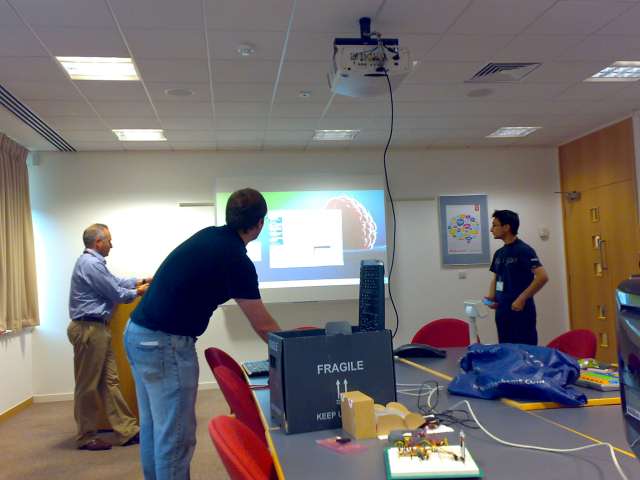
    So last night a bunch of us made our way down to Electrocomponents HQ again  for Oxford Raspberry Jam meetup number 3. As before, a fairly informal show-n-tell format with plenty of scope for discussion, and a lively exchange of ideas.
The serial terminal in action
    It was noticeable that people are starting to get to grips with the Pi's hardware. Our previous meeting has featured limited hardware demonstrations, but this time people had brought complete projects to show us. A serial display from a POS terminal, a Pi used as a network client for an audio industry control standard, and a very neat little serial terminal using an Atmel processor and destined to become a commercial product that can fit in the top of a Pi case.
    It was also encouraging to see a discussion of the Pi's application in education. How to capture the excitement of a huge bunch of kids when you only have a lunch hour to do it in. I realised at that point that I must have been an unusually geeky teen, having saved up my 30 quid for a second hand ZX81 I needed no such encouragement to get stuck in.
RiscOS blowing raspberries.
    On the software front we had a demonstration of the latest RiscOS build. Looking very slick, but with the intriguing promise of more to come as GPU support is included. I was a willing convert to RiscOS on my Pi because of its speed and ease of use, so I am especially looking forward to what the Pi and RiscOS community can achieve in porting more up-to-date software to the platform.
    I brought along two demonstrations to the meeting. The first was a shameless use of the Pi as an appliance, a DarkELEC image. This is an OpenELEC fork that includes all the clients for UK TV-on-demand services such as BBC iPlayer and 4OD. It's an impressive distribution in that it delivers very good performance from the Pi, and a stunning picture on the Electrocomponents meeting room TV. I must have made copies of the SD card for most people in the room.
    DarkELEC might seem a frivolous use of the Pi to some, but I think such appliance distributions are important. They mean more Pis will be used rather than lie forgotten on experimenters desks, and they provide a handle to gain the interest of young people in their Pi, making it more than just a geeky toy.
Yes, that's Internet Explorer 3. Best viewed in...
    My other demonstration was at the same time a joke and a serious demonstration of the Pi's capability. I ran Windows 95 in a Bochs virtual x86 machine over Debian on my Pi. And it was just about usable, despite no effort having gone in to tuning the Bochs setup. I can think of no practical application for Windows 95 on a Pi, but it is not impossible that perhaps someone might have to run a piece of legacy DOS software somewhere and might find Bochs a useful means to do it.
    Anyway, a few tech details. Bochs is in the Debian repository, so a simple apt-get installed it. I installed Windows 95 from the CD that came with a laptop in the '90s to a 100Mb Bochs hard disk image on my desktop PC and transferred it to the Pi on a USB disk. The Pi has no CD-ROM drive and I didn't fancy trying to extract the ISO file to do the task. I used the X-windows Bochs display library, so the Debian desktop was always present in the background of the Windows 95 session. A much faster result could probably have been achieved had I compiled the SVGAlib package and run it without X, but this was more a demonstration for the laughs than practicality. As I said, "You've seen an open OS on your Pi, now here's a wide-open one!".
    So that was it. Another Oxford Raspberry Pi meeting. I look forward to seeing you at the next one.

Monday, 2 July 2012

What was that about "Don't be evil"?

    I'm sure most readers of this blog will be familiar with the famous Google motto "Don't be evil". Having had the chance to look at Google culture from a viewpoint slightly closer than the average Joe it comes across as something taken pretty seriously within Google. When they say that, they really mean it.
    "Being evil" is generally taken as a reference to some of the shady practices found elsewhere in the tech industry. Really good examples of "Being evil" can be found in the history of Opera Software, as the underdog in the browser race they faced over a decade of unfair practices from the developer of the dominant browser.
    But things are different now, aren't they? MSIE is no longer the top dog, and there's a new kid in town. Chrome, from Google, and they have that "Don't be evil" motto, don't they?

    I use all the main browsers, I'm a web developer. I use Opera quite a lot, it's a damn good browser, just like Chrome or Firefox. I'm also a Google user, you might say I've drunk the Google Kool-Aid. So seeing screens like these three from flagship Google services running in the latest version of Opera (12.00) distresses me.


 I develop interactive web sites that work with all major browsers. Chrome, MSIE, Firefox, Safari and Opera. It's standard web developer stuff, not difficult at all. The web is full of HOWTOs, compatibility libraries and guides for the novice developer, so I'd expect the kind of experienced developers Google hires to have no problems writing code that works cross-browser. It's hardly as though Opera makes it difficult anyway, it's one of the most standards-compliant browsers on the market.
    So what I'm seeing is a major browser developer not making the effort to support a smaller competitor's product in their web servicess when I know that supporting that product is straightforward for a competent web developer. And then using the lack of support to display a message pushing users of the smaller competitor product to their own offering.


    "Don't be evil" is Google's motto. It pains me slightly to say this, but as an Opera user I don't think they're living by it here. Come on Google, step up to the plate!

Wednesday, 20 June 2012

MSIE overtaken

    Back in April I wrote a piece about the rise of Google Chrome and the pending loss to MSIE of the number one browser slot. Based on StatCounter GlobalStats data I predicted that this would happen in June.

    I was wrong. It happened in May. Finally we're in an era in which supporting outdated, insecure, and non-standards-compliant browsers is no longer considered a priority.

    It would be tempting to slam MSIE. Hell, the product deserves it! But I hope losing the top spot reveals Microsoft at their best. When they're top dog they don't behave well, but when they're the underdog, they innovate. It would be great to see a future version of MSIE that really gave Chrome and Firefox a run for their money, a super-fast, secure, up-to-date, non-proprietary, and standards-compliant browser.

    Well, I can hope, can't I.

Tuesday, 19 June 2012

Oxon-RaspberryPi meetup 2

   Here's a quick report on my return from the second meeting of the Oxon-RaspberryPi group.

    So, about twenty people gathered in the meeting room at Electrocomponents on Oxford Business Park. Electrocomponents are the parent company of RS, one of the companies selling the Raspberry Pi, so a massive thank you to them for allowing us to use their space, and for providing us with some very interesting insights into some of the details behind their Pi offering.
    It was interesting to see the diversity of attendees, of their interests and level of expertise. We were treated to demonstrations of XBMC media centres running on a Pi, of a wireless serial link between a Pi and an Arduino, to a demo of simple GPIO interfacing and to my favourite of the evening - a Pi running RiscOS. My demo of a Pi running the Natural Language Toolkit seemed paltry by comparison.
A Pi running RiscOS
    Most importantly we discussed the idea of a group project, something diverse enough to allow all group members to contribute yet unique enough to allow us to contribute something to the Pi community. Several good ideas have been proposed, no doubt a front-runner will have emerged by the time we next meet.
    So all in all a positive experience. One of my fellow attendees remarked to me as we left that it was likely some of the major tech businesses of the coming decade would receive their start from the Raspberry Pi. I thought of the Silicon Valley garages of a few decades ago and couldn't help but agree. Where did we lose our way, back in the 1990s?

Thursday, 24 May 2012

Life with Pi

    My Raspberry Pi single board computer arrived just over a week ago after a long wait for my ordered unit to be manufactured and shipped. I wrote back in early March about my thoughts on the product launch and I outlined my plans for the device a couple of weeks ago, now I've had it in my possession for a week here are my thoughts about the board itself.
    On first unboxing the unit my reaction echoed those of other reviewers, this is a small device. Of course we all knew it would be credit card sized, but having the board in front of you really brings that home. We've become so conditioned to computers requiring significant space for peripherals and heat management that one without that need is something of a shock.
    Gathering together the required peripherals was an easy task. I already had network and audio cables, as well as a micro-USB phone charger and my venerable Logitech wireless keyboard and mouse combo. I had to buy an HDMI to DVI cable because my TV is in reality an Acer monitor hooked up to a PVR and doesn't have HDMI. Thankfully the days of crazy pricing for DVI or HDMI cables are behind us.
    Similarly, downloading the Debian Squeeze reference distribution from the Raspberry Pi website and installing it on an SD card was very straightforward. Some SD cards have been reported as having problems with the Pi, I can confirm that my Lexar 8Gb SDHC card has no such issues.
    So with all peripherals and software in place and connected, I turned on the telly and plugged in the phone charger. Without fuss, the LEDs on the Pi lit up, and the Linux boot screen appeared on the TV. Success!
    Success, that is, until it hung during the boot process. But a very helpful message explained that this can happen at first boot and simply rebooting the device would fix matters. A further reboot and login process, and I had a bash prompt. My £25 Linux PC was a reality.
    Given a working computer with a Linux command line, the world is your oyster. I am reviewing the hardware for this piece rather than the software because I feel every Pi owner will have their own plans for the device and simply describing a Linux distribution will be of little interest. So the software is only described in this piece in scant detail, and to give an idea of the speed of a Raspberry Pi compared to a more familiar computer.
    So I typed startx at my prompt, and was rewarded with the LXDE desktop. As a simple first task, I loaded the BBC Weather site and then GMail in the bundled Midori browser. Hardly heavy stuff, but it gives a good idea of the speed involved.
    I have heard the Pi described as having performance similar to a Pentium II with a very fast graphics adaptor. By coincidence one of my desktop PCs is a Pentium II 266 running Lubuntu, so given that the Pi's Debian does not yet have driver support for the graphical acceleration I would say that the performance of both machines is very similar indeed. Browsing is a usable experience, but a slow one. A typical web page will take over ten seconds to render, but in-page Javascript features are usable in real time once the page has loaded. Services like GMail for instance are a bit slow-feeling, but not so slow as to be impossible to use. Having used the Pentium II as my main development platform for several years before moving to my laptop I do not expect a Pi with similar performance to struggle with the kind of scripts I am likely to use it for. On that note, I installed the Python Natural Language Toolkit package which will be a significant plank of the project I plan on using my device for.
    If I have any software gripes, they are minor and will I am sure be fixed in future distributions. The image is for a 2Gb SD card, and though instructions are readily available online for extending the partition onto a larger card they are not for the faint hearted and would benefit from being made easier as part of the Pi distribution. GPartEd is bundled and might perform this task but trying to use it revealed a further gripe; the administrator password doesn't seem to be available. Of course I could use sudo from the command line to achieve this aim by other means, but to someone with little knowledge of Linux this would be a show-stopper.
    I would like my Pi to run full-time next to my router, processing keyword data. To this end my interest in the Pi centres on its low power consumption and heat dissipation, I do not want a traditional PC with all its heat issues running full-time in my home. I put the Pi to the test on this front by constantly reloading the BBC website for several minutes in Midori, causing the CPU graph to show as maxed-out. If the Pi had a traditional Intel processor then merely running LXDE would cause it to be too hot to touch, as it was I could put my finger on the Pi's memory/processor combo and feel that it was merely discernibly a bit warmer than its surroundings.
    The Pi's small size means that there is plenty of space behind my telly for it next to the router. But with a bulky HDMI cable plugged into it there was something of a feeling of the tail wagging the dog as the weight of the cable threatened to pull the board with it. Also the board layout with cables on all sides meant that positioning it was slightly difficult. But that is an acceptable compromise as has been explained by the Raspberry Pi team, for reasons of size and cost. My solution to the mechanical issues of a small board held only by a selection of cables was to make a simple case from a surplus business card box, a speedy procedure involving a set of nail scissors. This case does not seem to result in the Pi becoming too warm, and will probably end up being fixed to the router using sticky Velcro pads.
    In conclusion, after a chance to play with my Pi I am still extremely impressed by it. Sure, the software distribution has a few very minor gripes, but this is very much still a product in development by a volunteer organisation. Some care is needed in mounting or enclosing a Pi to protect it from damage, but that is no more than would be expected for any printed circuit board. Otherwise it is an extremely powerful computer for its exceptionally low price and with a low power consumption, so I look forward to it spawning the same diversity of creative computing that its 8-bit forebears did. If you haven't ordered one, do so now!